BioListener Sleep
Closed-loop neurostimulation system for sleep onset optimization, adapting stroboscopic light and generative audio to live EEG. Part of BioListener, an open-source ecosystem designed to revolutionize biosensing with portable, affordable, multi-channel biosensing boards.
Research stage. BioListener Sleep is researched in simulation and on an integration test harness; sessions with real subjects are a feasibility check only. It is research software, not a medical device, and makes no claim that it helps anyone fall asleep.
How it works
A closed loop that runs four times per second
Most stimulation devices play a fixed program and read nothing from the person. BioListener Sleep measures the person while it stimulates, and keeps adjusting.
- 1
Read EEG
The BioListener board records brain activity (EEG) from passive electrodes on the scalp.
- 2
Choose the stimulation
A controller trained with deep reinforcement learning chooses the next stimulation setting.
- 3
Enforce safety limits
A separate safety supervisor clamps every requested action before it reaches the hardware.
- 4
Drive light and audio
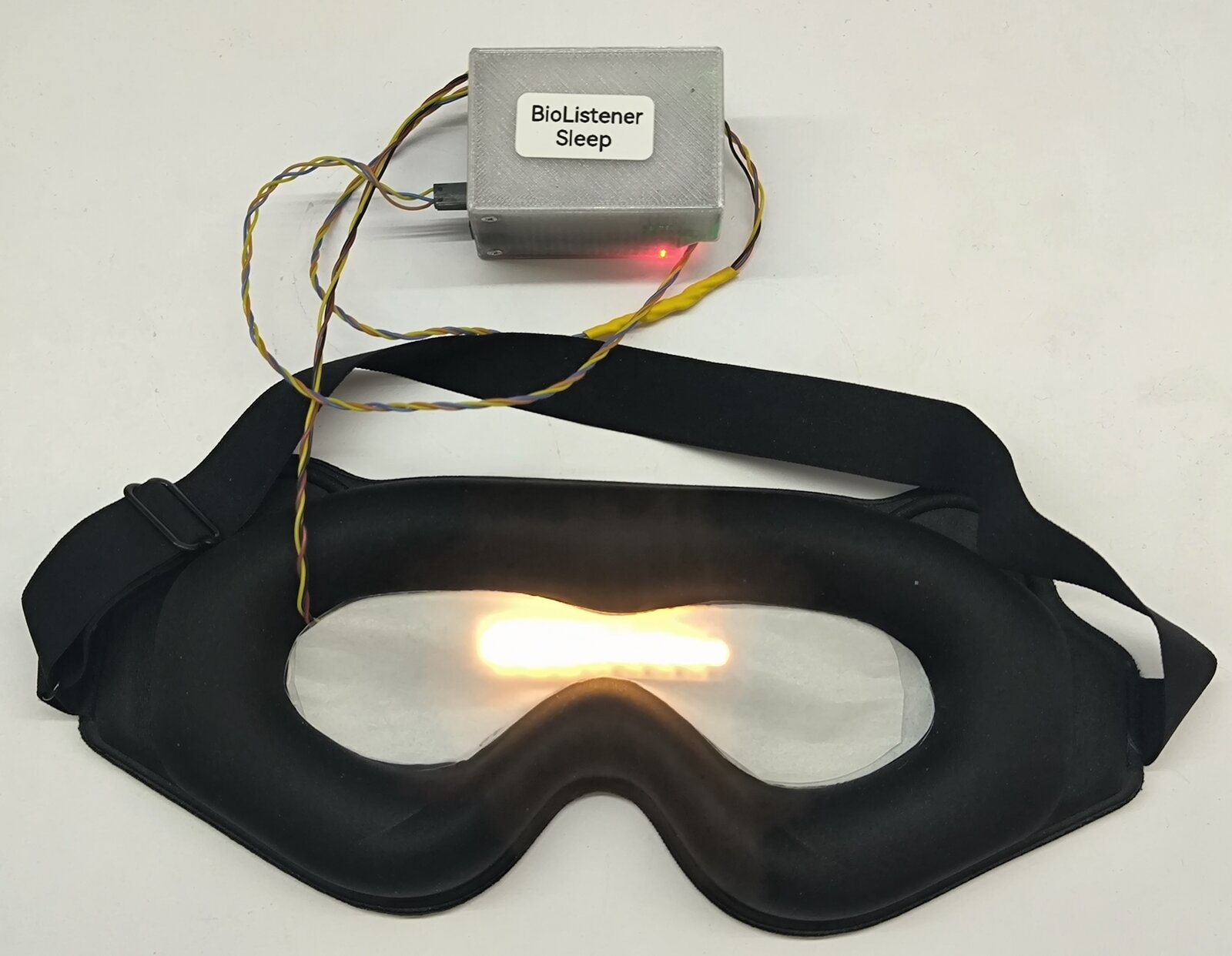
The command drives a stroboscopic LED mask and an audio engine. Then the loop repeats.
The research
A testbed for closed-loop stimulation
One research question
If a learned controller drives stimulation from live EEG, what should it be rewarded for? The project studies this reward design.
Trained in a brain simulator
The controller learns in a simulated model of brain cortex, cross-validated against The Virtual Brain, a standard library in computational neuroscience.
Run end to end on hardware
The full loop has run with a person on the BioListener board and the LED mask, monitored from a browser console with a panic stop.
Get in touch
Questions, collaboration, or contributions: write to us, or open an issue or pull request in the relevant repository.